Emergency Guides
How to Safely Handle Storm-Downed Power Lines and Entangled Trees in Mercer County
By Master Tree RemovalJanuary 21, 20266 min read
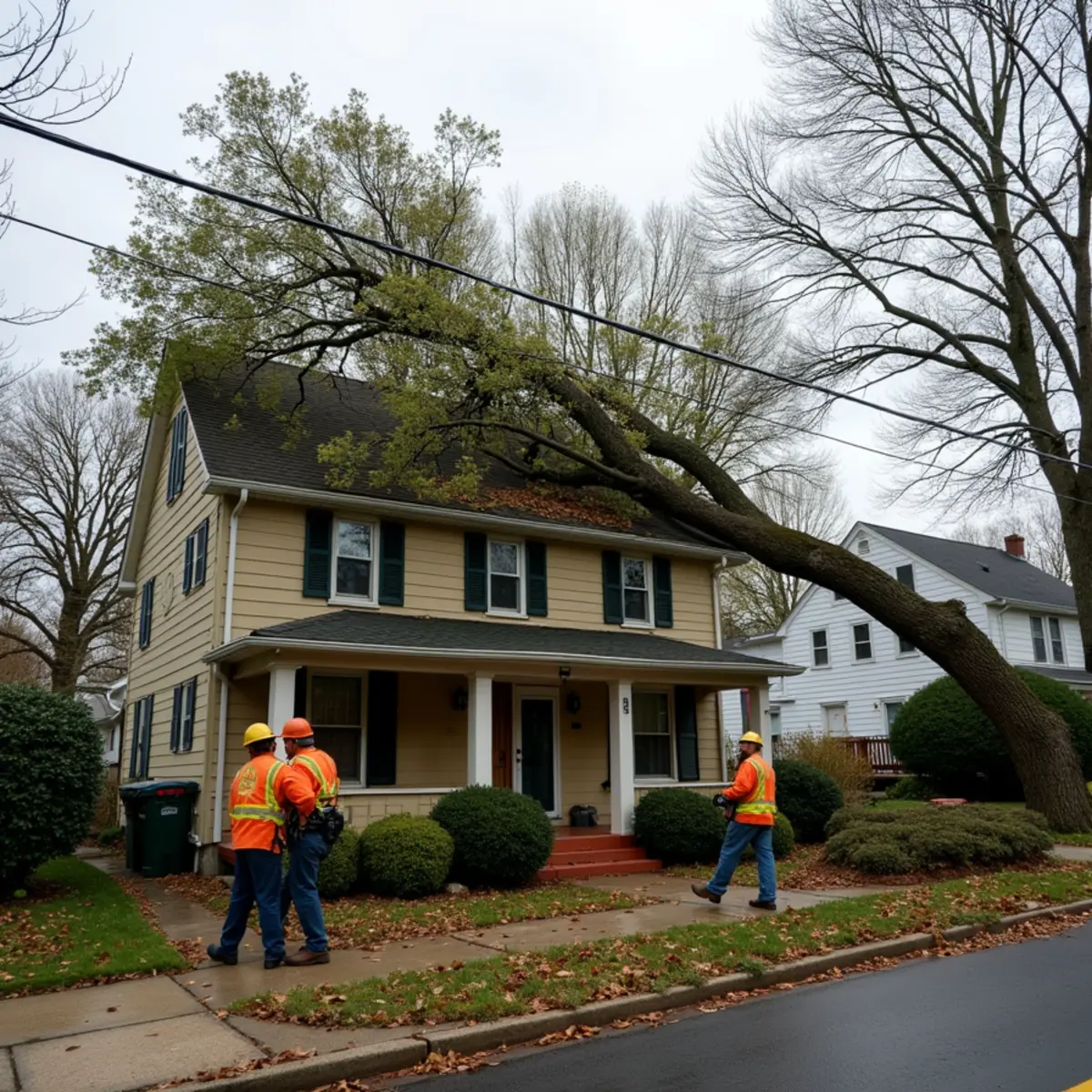
Every storm season, trees and branches come down onto power lines across Mercer County. It is one of the most dangerous situations a homeowner can face, and the single most important rule is simple: assume every downed line is live and stay away from it.
Power-line hazards rarely arrive alone — they come with the same storms that drop trees onto houses and the heavy wet snow that snaps NJ pines, so the safety rules below apply well beyond the wire itself.
The 30-Foot Rule
Keep yourself, your family, and your pets at least 30 feet from any downed or sagging line — and from anything it might be touching, including the tree, a metal fence, a puddle, or a vehicle. Electricity can travel through all of them. A line does not need to be arcing or sparking to be energized and lethal.
Who to Call, and in What Order
Call 911 or your utility first for any downed line, fire, or injury. Report the exact location and stay on the line if the dispatcher needs details. Only after the utility has de-energized the line and confirmed the scene is safe should tree work begin. Our crews coordinate with the utility for line-adjacent hazards — we do not cut energized conductors, and neither should anyone else.
Limbs Hung Up Over Lines
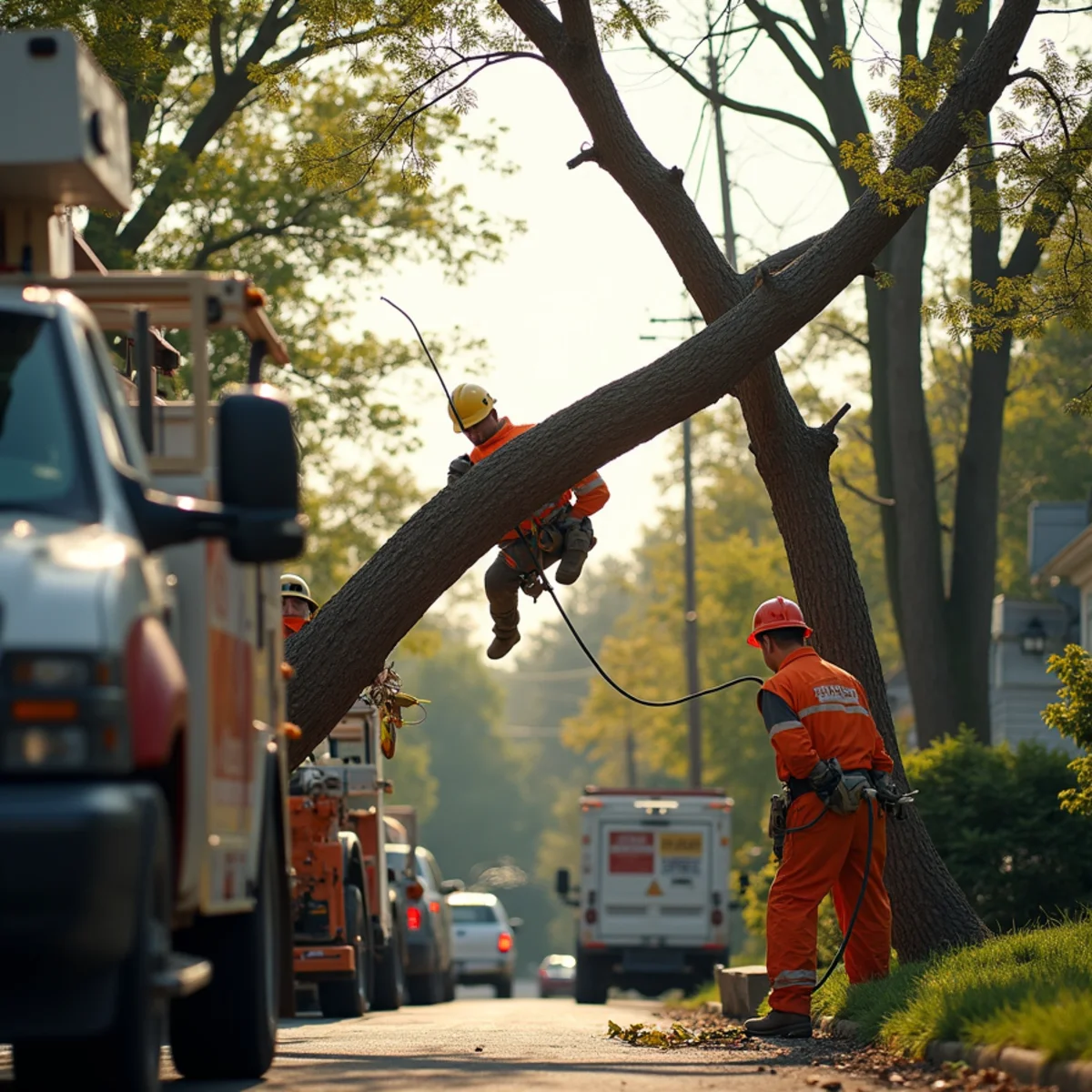
A cracked or broken limb resting on or near a service drop is a classic Mercer County hazard, especially in Hamilton and other townships where mature oaks and maples overhang the streetscape. Do not try to knock it down. Our hazardous and hanging limb removal service uses roped, controlled techniques — after utility coordination — to lower the limb clear of the wires and the ground below.
After the Utility Clears the Scene
Once the line is safe, the tree still has to come down or be made safe. That is where our storm cleanup and tree recovery crews take over: relieving tension, removing the failed sections, and hauling debris. If the outage or damage was widespread, our emergency tree service triages by severity across Mercer County.
Prevent the Next One
Utility-adjacent trees should be inspected and pruned for clearance before storm season. Deadwood, end-heavy limbs, and prior storm cracks over a service drop are exactly what fails first. A little proactive clearance work is far cheaper — and safer — than an outage and an emergency call.
If a tree is on a line near your home, call your utility now. Once they’ve made it safe, we’ll handle the tree.
What the Utility Does — and What We Do
These are two different jobs, and the order matters. The utility owns the wire: only they (or the fire department) can confirm a line is de-energized and safe. We own the tree — but not until the electrical hazard is cleared. When you call us about a line-adjacent tree in Mercer County, our first question is whether the utility has been out yet. If not, we tell you to call them and stay back.
Once the scene is electrically safe, our crews take over the tree work: relieving tension, removing the failed sections, and clearing debris. We never cut energized conductors, and no reputable crew will.
Mistakes That Turn Dangerous Fast
- Assuming a line is dead because it isn't sparking. Downed lines can be energized and silent.
- Moving a branch touching a wire. Wood, metal fences, and wet ground all conduct electricity.
- Driving over a downed line. Stay in the vehicle if a line falls on your car and call 911.
- Letting kids or pets near the scene. Keep a 30-foot perimeter until the utility clears it.
Utility-adjacent trees are best pruned for clearance before storm season, not after an outage. If a tree is on a line near your home, call your utility now — then call us at (855) 615-0568 for the cleanup once it's safe.
After the Line Is Clear: Getting Your Property Back
Once the utility de-energizes the line and confirms the scene is safe, the tree still has to come down or be made safe — and that's where a storm-response crew earns its keep. A tree that's been resting against a service drop is often under tension, partially uprooted, or tangled with the drip loop at the house. We relieve that tension in a controlled sequence rather than freeing it all at once, so nothing springs back toward the structure or the crew.
We also document as we go. If the tree damaged your weatherhead, mast, or meter enclosure, that's usually the homeowner's responsibility to repair through an electrician before the utility will reconnect — and photos of the damage help both your electrician and your insurer. Our storm cleanup crews hand off a clean, documented scene so the reconnection isn't held up by debris.
Preventing the next line strike
Most line-adjacent failures are predictable. The limbs that take down a service drop are usually deadwood, end-heavy laterals, or storm-cracked branches that were visible months earlier. Clearance pruning before the season — keeping growth back from the drop and removing the deadwood above it — is far cheaper than an outage, an emergency call, and an electrician. For properties across Hamilton and the rest of the county, we build that clearance work into a maintenance schedule so the same limb doesn't threaten the same wire every storm.
One caution worth repeating: the drop from the pole to your house is often the homeowner's side of the connection, but you should never assume which conductor is whose. Treat every line as live, keep the 30-foot perimeter, and let the utility confirm before any tree work starts.
Generators, Space Heaters, and the Second Wave of Danger
The tree and the wire are the obvious hazards after a storm, but the outage that follows brings its own. Every widespread event in Mercer County is followed by carbon-monoxide calls and house fires from generators run in garages and space heaters left too close to furniture. If a downed tree has knocked out your power, keep any generator well outside and away from windows, and never run one indoors. It's a grim irony that the fallen tree sometimes isn't the thing that hurts someone — the improvised heat afterward is.
Keep a clear head about priorities, too. A tree resting on a still-connected service drop is a wait-for-the-utility situation, not a clear-it-yourself one, no matter how long the outage runs. We've been called to yards where a homeowner, cold and frustrated on day two of an outage, started cutting near a drop that turned out to be live. Patience here is not optional — it's the whole safety margin.
Once power is restored and the utility has released the scene, we move quickly on the backlog of tree work these storms create, prioritizing access-blocking and structure-threatening trees first. If your property is still dealing with a line-adjacent tree, get on the list early: call (855) 615-0568 so we can schedule the cleanup the moment it's safe to work.