Local Angles
Delaware River Bluff Tree Instability: Managing Leaning Hardwoods and Slope Erosion
By Master Tree RemovalMay 6, 20266 min read
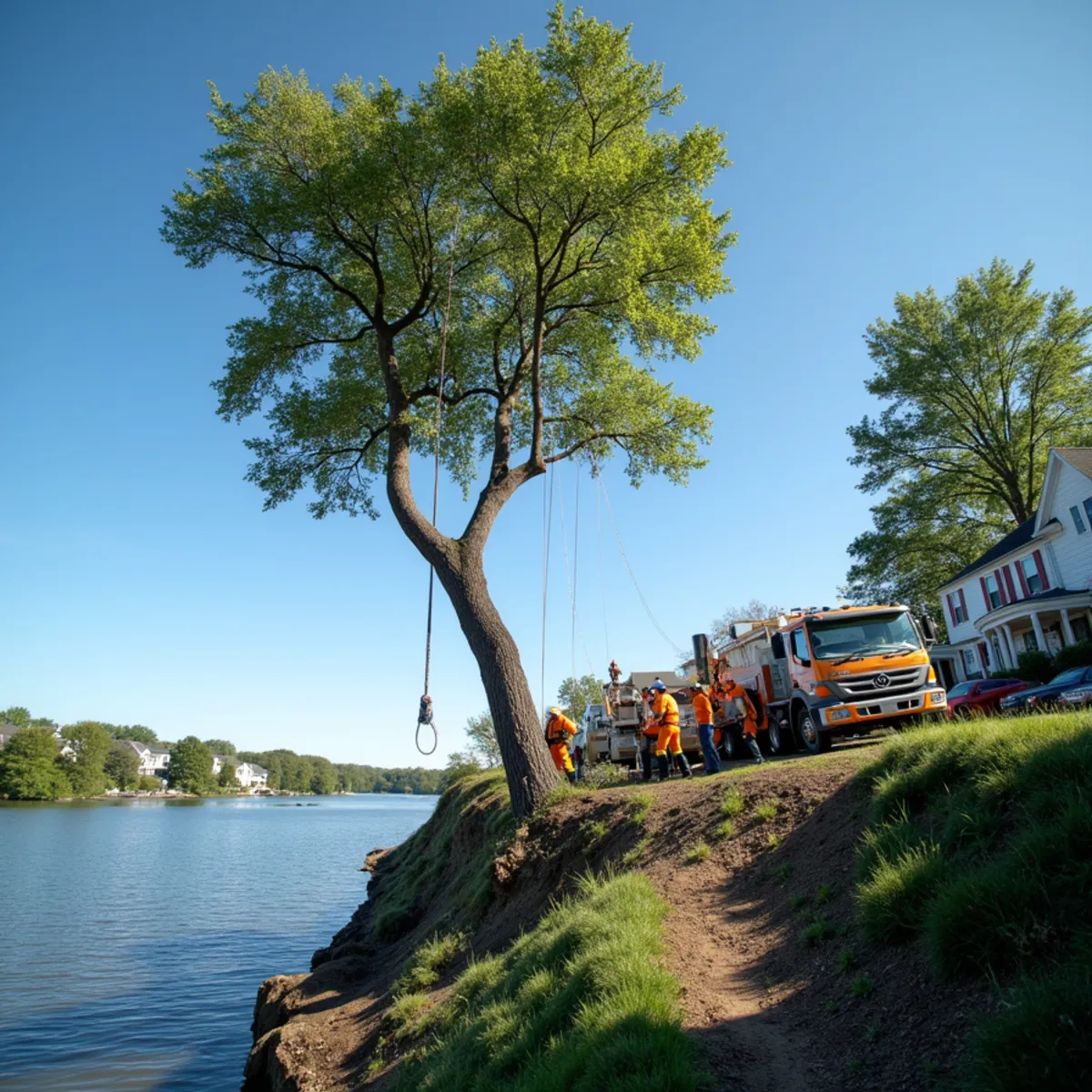
The bluffs above the Delaware River give towns like Bordentown and Lambertville their character — and their trees a precarious footing. As banks erode, hardwoods rooted into the slope begin to lean, and a lean over a home or roadway is a warning that should never be ignored.
Slope removals rarely have a safe drop zone, which is why they lean on crane and precision-rigging technique, and why a healthy-but-leaning bluff tree is often a candidate for cabling and bracing rather than removal.
Why Bluff Trees Lean
Slope soils are constantly on the move. Heavy rain saturates and undercuts the bank, roots on the downhill side lose their grip, and gravity does the rest. A tree that stood straight for decades can develop a pronounced lean over a season or two of wet weather. On the steep confluence bluffs of Bordentown and the terraced hillsides of Lambertville, this is a routine hazard.
Warning Signs to Watch
- A new or increasing lean, especially after heavy rain
- Lifted or cracked soil on the uphill side of the base
- Exposed roots as the bank erodes away beneath them
- Soil slumping or small slides on the slope
Any of these near a structure, driveway, or road warrants a professional look. One sign alone is not a diagnosis, but movement plus exposed roots is a serious combination.
Why Slope Removals Are Technical
Bluff-side trees rarely have a safe drop zone, and equipment often cannot sit on the slope. That makes these jobs prime candidates for precision rigging or crane-assisted removal, lifting sections up and away rather than dropping them downhill toward whatever sits below. Our tree removal crews plan each pick around the terrain, access, and what is at risk.
Managing, Not Just Removing
Not every leaning bluff tree has to come down. Where the root plate and lean allow, monitoring and selective work can preserve a tree while reducing risk. A care plan that includes an inspection after heavy rain is the smartest approach for bluff-front owners.
Worried about a leaning tree on your bluff-front lot? We’ll assess it and recommend the safest path.
Warning Signs a Bluff Tree Is Moving
- A new or increasing lean, especially after heavy rain
- Lifted or cracked soil on the uphill side of the base
- Exposed roots as the bank erodes beneath them
- Soil slumping or small slides on the slope
Why Slope Removals Are Technical Work
Bluff-side trees rarely have a safe drop zone, and equipment often can't sit on the slope. That makes these jobs prime candidates for precision rigging or a crane reaching from stable ground, lifting sections up and away rather than dropping them downhill. Our removal crews plan each pick around the terrain, access, and what sits below. On the bluffs of Bordentown and Lambertville, that planning is the difference between a controlled removal and a slide. Worried about a leaning tree on your riverfront lot? Call (855) 615-0568.
How Erosion Undermines a Tree You Can't See Failing
Bluff trees fail from the bottom up, and the early stages are underground. As the Delaware and its tributaries cut at the bank, they carry away the soil that anchors the downhill roots. The tree looks fine — full canopy, no obvious lean — right up until enough root support is gone that a wet season or a storm tips it. By the time the lean is obvious, the root plate is already compromised, which is why we treat any bluff tree with exposed roots or a fresh lean as a priority assessment, not a someday project.
Slope soils are also in near-constant slow motion. Freeze-thaw, saturation, and gravity work the ground downhill year-round, so a tree on a terraced Lambertville hillside or a Bordentown ravine is fighting a moving foundation its whole life. That's the context behind the warning signs — lifted soil on the uphill side, exposed roots, small slumps in the slope — that we tell riverfront owners to watch for after heavy rain.
Removing a tree without triggering a slide
The removal itself has to respect the slope. There's rarely a safe drop zone, and heavy equipment can't sit on an unstable bank, so these are crane or technical-rigging jobs that lift sections up to stable ground. We also think past the stump: if the roots were holding soil, pulling everything out can accelerate erosion, so sometimes the right call is to grind flush and leave the root mass, or plan replanting to stabilize the bank. Our removal crews plan each pick around the terrain and what sits below — the house, the neighbor, the water. On a bluff, the tree and the ground are one problem, and we treat them that way.
Protecting the Bank as Well as the Tree
On a river bluff, the tree and the slope are one system, and good management treats them together. Trees are part of what holds a bank — their roots bind the soil against the erosion that undercuts it. That creates a real tension: a leaning, failing tree is a hazard you want gone, but the roots of a healthy tree are doing structural work you don't want to lose. The right call depends on the specific tree, and it's rarely as simple as "cut it down."
Where a tree is genuinely failing, we plan the removal to minimize slope disturbance — lifting sections up to stable ground with a crane or rigging rather than dragging them across the bank, and often grinding the stump flush and leaving the root mass in place to keep binding soil. Where a tree is stressed but not yet dangerous, monitoring and selective work may preserve both the tree and the stability it provides.
For bluff-front owners in Lambertville and Bordentown, the smartest move is an inspection after heavy rain, when the warning signs — lifted soil, exposed roots, a new lean, small slope slumps — are most visible. Catching a bluff tree while it's still stable enough to work safely is far better than waiting for it to become an emergency on ground that can barely hold equipment. Our removal crews and care plans are built for exactly this terrain. Worried about a riverfront tree? Call (855) 615-0568.